
How to Cut Porcelain Tile with a Manual Tile Cutter (7 Steps)
Last Updated: 2026-11-09 · By HESSENG · 7 min read
Short answer: mark the cut on the glazed face, set the tile against the cutter's square, make one firm, even scoring pass from the far edge to the near edge, then press the breaker down near the edge of the tile to snap it along the line. Smooth the cut edge with a rubbing stone. Porcelain is denser than ceramic (water absorption of 0.5% or less, the threshold used in ANSI A137.1), so it needs a sharp wheel and a single, steady pass. Pressing harder does not help.
What you need
- A manual (push) tile cutter longer than your longest cut. See the size table below.
- A sharp tungsten-carbide scoring wheel. Replace it when the score line turns fuzzy or the glaze chips.
- A pencil or fine marker, a tape measure and a square.
- A rubbing stone or diamond hand pad for the edge.
- Safety glasses and cut-resistant gloves. Snapped porcelain edges are as sharp as glass.
How to cut porcelain tile in 7 steps
- Check the wheel and the rail. Run the scoring head along the empty rail. It should glide without play. Clean grit from the rail and the bed; a grain of grit under the tile lifts it and the score wanders.
- Mark the cut on the glazed face. Measure twice and allow for the grout joint. On large tiles, mark both ends of the line, not just one.
- Seat the tile. Glaze side up, push it firmly against the cutter's fence or square. Line up your mark with the center guide line on the bed, which sits directly under the breaker. The whole tile should lie flat on the bed. Large-format tile that overhangs needs extra support at the same height.
- Score once, far to near. Lower the wheel at the far edge of the tile, about 1 cm in, and push it toward you in one continuous pass at even pressure. Some cutters score by pulling instead; follow the maker's direction. Do not stop halfway and do not go over the line again. You should hear a steady, even "zip" and see a fine, continuous line.
- Position the breaker. Move the head back so the breaker foot sits on the tile about 2–3 cm from the near edge, centered on the score line.
- Snap with steady pressure. Press the lever down gradually. Do not strike it. Porcelain usually breaks with a sharp crack along the full length. If it does not break, raise the pressure slowly rather than moving the breaker.
- Smooth the edge. Rub the cut edge with a rubbing stone at a slight angle to take off the sharp arris. On visible edges, finish with a finer diamond pad.
What cutting length does each tile size need?
The cutting length printed on a cutter is the longest cut it makes in one pass. For diagonal cuts, you need the length of the tile's diagonal, not its side. We calculated the diagonals below and matched each size to the shortest cutter in our range that covers it.
| Tile size | Straight cut | Diagonal cut | Shortest model that covers both |
|---|---|---|---|
| 30 × 60 cm (12 × 24 in) | 60 cm | 67 cm | HS5602, 80 cm |
| 60 × 60 cm (24 × 24 in) | 60 cm | 85 cm | HS5602, 100 cm |
| 80 × 80 cm (32 × 32 in) | 80 cm | 113 cm | HS5602 or HS5601, 120 cm |
| 60 × 120 cm (24 × 48 in) | 120 cm | 134 cm | HS5601, 160 cm |
| 120 × 120 cm (48 × 48 in) | 120 cm | 170 cm | HS5601, 180 cm |
| Slabs over 180 cm | — | — | HS5603 rail system (200 cm rail) |
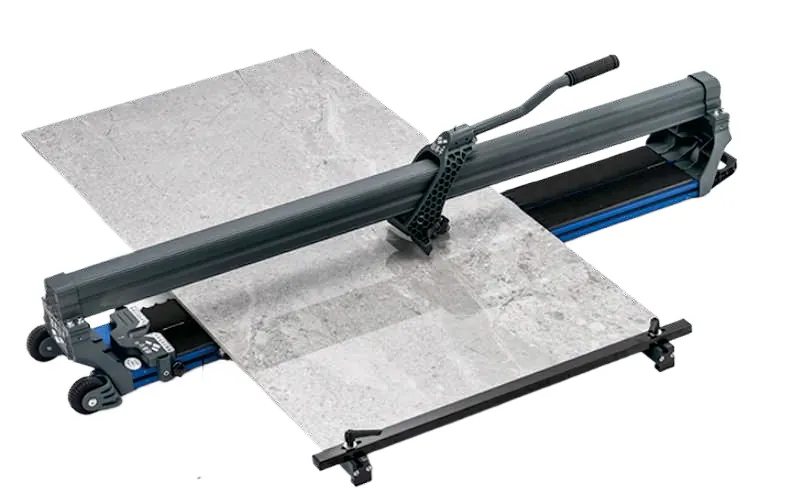
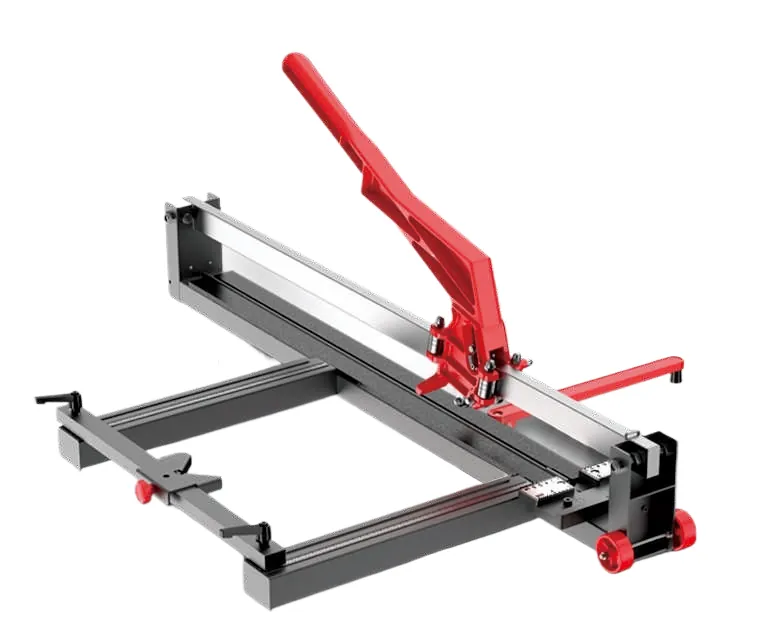
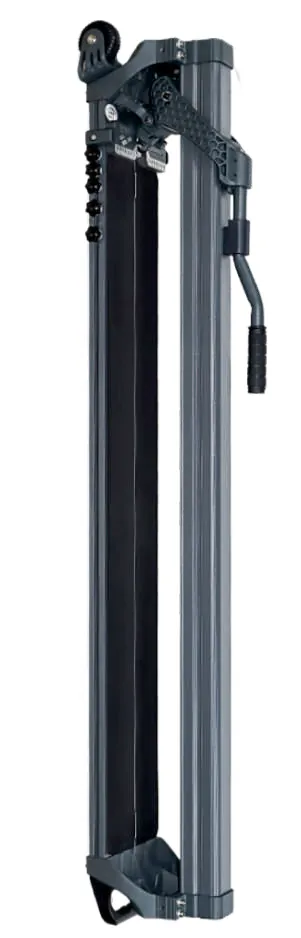
Our HS5602 steel-frame cutter comes in 80, 100 and 120 cm cutting lengths and covers wall tile and most floor tile up to 80 × 80 cm. The HS5601 aluminum-rail cutter (120, 160 and 180 cm, with a 30–58 cm adjustable-height base) is for large-format porcelain. For slabs longer than that, the HS5603 rail system lays a 200 cm rail directly on the slab. See all sizes side by side on the manual tile cutters page.
Why porcelain chips or breaks off the line
| What you see | Likely cause | Fix |
|---|---|---|
| Glaze chips along the score | Worn wheel, or scored twice | Replace the wheel; score once only |
| Break curves away at the end | Pressure dropped at the edge, or breaker too far in | Keep pressure to the last centimetre; breaker 2–3 cm from the edge |
| Tile cracks across, not along, the line | Tile not supported; overhang flexes | Support the overhang level with the bed |
| Score line wanders | Play in the scoring head, or grit on the rail | Clean the rail; a cutter with a rigid rail and bearing head holds the line |
When a manual cutter is the wrong tool
A manual cutter only cuts straight lines from one edge to the other. For L-shaped notches around door frames, holes for pipes, curves and strips narrower than about 2 cm, use a wet tile saw, an angle grinder with a porcelain diamond blade, or tile nippers. Many installers keep a manual cutter for the straight cuts, which are most of them, because it is dust-free, quiet and needs no water or power.
For distributors: which lengths to stock
Retail and DIY ranges usually stop at 100–120 cm. Installers who lay 60 × 120 cm and larger porcelain buy 160–180 cm cutters. If you are building a tile cutter range under your own brand, tell us your channel and the tile sizes your customers lay, and we will suggest a length mix. Read how OEM and private label orders work, or ask for a quote below.
FAQ
Can a manual tile cutter cut porcelain tile?+
Yes, for straight and diagonal cuts. Porcelain is harder than ceramic, so it needs a sharp carbide scoring wheel, one steady scoring pass and a cutter with a strong breaker. Very thick outdoor porcelain pavers may exceed the thickness a manual cutter is built for; check the cutter rating before you buy.
Why does porcelain tile break off the score line?+
The usual causes are a worn scoring wheel, scoring twice over the same line, uneven pressure during the pass, or a breaker foot placed too far from the edge. A tile that is not fully supported along its length can also flex and crack away from the line.
Should I score porcelain tile twice?+
No. A second pass rarely follows the first groove exactly. It widens the score, chips the glaze and blunts the wheel. If the first score is too light, start again on a new tile, or reset the cut a few millimetres away.
When do I need a wet saw instead of a manual cutter?+
Use a wet saw, angle grinder or hole saw for L-shaped notches, curves, holes for pipes and very narrow strips. A manual cutter only makes straight cuts from edge to edge.
What cutting length do I need for 60 × 120 cm porcelain?+
At least 120 cm for a straight cut along the long side, and about 135 cm if you also cut it corner to corner. The table in this guide lists the length needed for common tile sizes.